
The language service provider market is complex and the cost of translation ranges from high-end to pocket friendly.
So how can you know what’s a fair rate? It depends on what you need, and how fast.
Here’s what can’t be argued: Poor translation can result in the tarnishing of your corporate reputation, a drop in brand image, and missed sales opportunities.
It’s very important that your language translation service partner offers quality, accuracy, and affordability.
Let’s look at how to make the best choice for your business or organization.
Cost of Translation Factors
Usually, the most important languages for global business have higher demand. This means the more translators there are for a language, the lower translation rates.
Conversely, specialized languages with fewer available translators will result in high translation costs.
These general rules don’t always stand, and there are other factors to consider for the cost.
Volume or Word Count
The basic pricing unit in the translation industry is “cost per word.” The higher the number of words, the higher the total cost.
Language service providers can, however, offer discounts and special “per word cost” on large volume projects, but this practice is largely restricted to non-technical content.
Technical content requires specialized translators and therefore command a higher price per word.
Tools and Technologies Used
Machine translation is a big part of the process these days. LSPs make use of a variety of software such as translation memory tools, translation management systems, multilingual CMS, and translation APIs to get the job done.
Additionally, there is always a regular set of standard tools such as Excel, PowerPoint, PDF, and Photoshop that are used to translate and create the entire project.
If your project requires advanced tools, the language translation cost will surely be higher.
TAT (Turnaround Time)
The faster the turnaround time (TAT) required, the higher the cost.
Translators and agencies could charge a “rush fee” for an expedited TAT, as they might have to work extra-long hours or through holidays and weekends to complete a rush job.
Sometimes large language translation agencies with a well-knit network of translators may waive off the extra charges and the cost may remain the same as projects with regular TATs.
Project Management
To achieve cost effectiveness (especially in large projects), many people are required: native translators, good project managers, localization experts, quality assurance experts, and client servicing professionals.
Managing multiple translators and multiple languages in various time zones requires skilled project management. This is part of the project cost, and it’s money well-spent to save a huge amount of communication and coordination effort.
Specialization or complexity of content
Industry-specific translation requires subject matter experts (SMEs).
Medical or legal documents require translation of certain terms and contexts. For example, translating legal documents for other countries means that you need a local legal expert as well as a language expert. This all results in a higher cost.
Services Beyond Translation
Basic translation cost is calculated on a per word basis, but most projects also come with additional needs. They include:
These are charged separately as they require different branches of the language solutions team.
Cost of Translation Continuum
We put this simple chart together to help you get thinking about your translation priorities.
It shows that different approaches yield different results in terms of price point (cost per word), quality (fluency and adequacy of the translated text), and speed (words translated per day), moving along what we call the cost of translation continuum.
Expectation vs. Reality
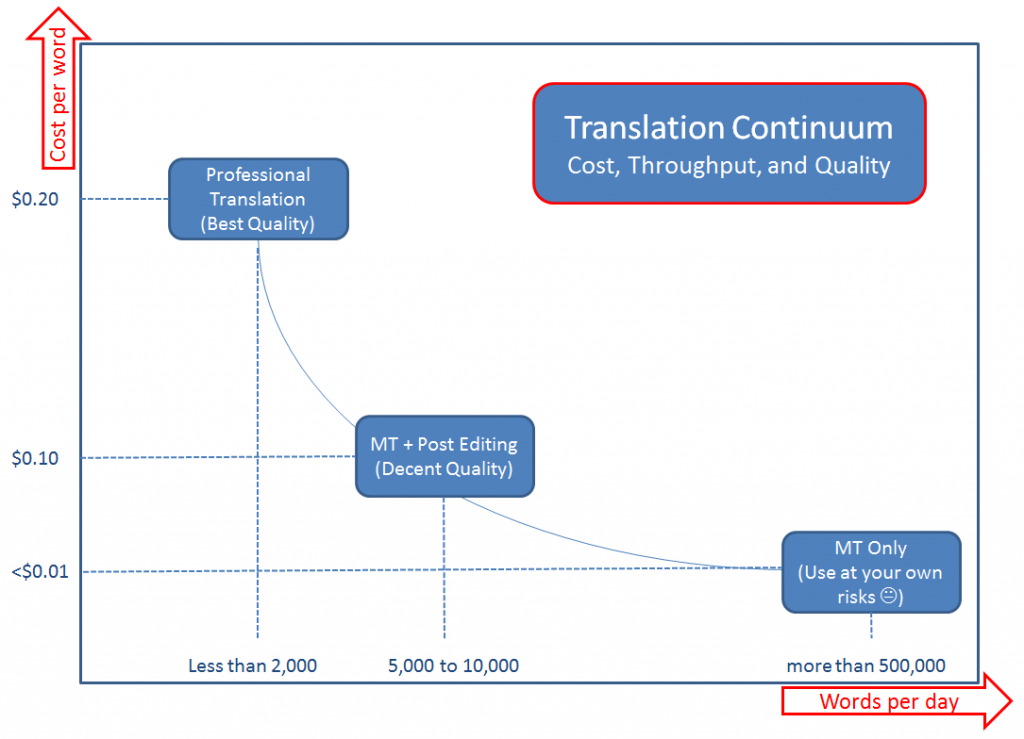
If perfection is required, a professional translator or editor will need to work on your content. Professional, human translation will give you the highest quality work, but it comes at a cost.
If speed of execution is the main factor, MT has to be part of the solution; it’s almost a no-brainer. Purely machine-based translation can get the work done at a much lower rate, but you sacrifice quality in the end.
Machine translation with human quality assurance is where you’re likely to find the balance between quality and cost efficiency. A combination of MT plus post-editing and crowdsourcing can help achieve lower price points without sacrificing quality or throughput time.
Evaluating Your Needs
At Summa Linguae, we consider all the factors before rolling out a custom price.
No two projects are the same. The level of complexity and resources required for each are different. That’s why we believe in treating every project differently, catering to its unique needs.
First and foremost, you must know what exactly you need. Make a detailed list of the languages into which or from which you need to translate and decide on the level of language services your company needs.
Will you need translation or localization? And is it a one-time need, or will there be ongoing projects?
Website blog translation can be a fully regular service. For example, if you need to translate one article every Tuesday at 3 p.m., a translation agency can designate a person who will always do this job – regardless of the language or specialization.
Or if your company organizes e-learning courses for employees around the globe, a one-time localization project allows for this valuable content to be made relevant for all.
Maybe you’re ready to launch your website into foreign markets. For your advertising to succeed, you need to hire a creative translation services who can transcreate for you. Professional transcreation services are available to help businesses like yours truly connect with foreign cultures. Make sure you find these specific services – not just translation.
The more detailed information you provide to the person quoting for your translation needs, the greater the chance that you will be offered the most attractive price. And if you don’t know exactly what you need, we can help figure it out.
Get the Best Translation and Localization Service
Summa Linguae specializes in technology-enabled translation and localization solutions.
We combine the best of what human intelligence and machine learning have to offer to bring your business to more people around the world—quickly, efficiently, and affordably.
Taking an outcome-based approach, we tailor a language solution to meet your objectives. A fit-for-purpose strategy that simplifies even the most complex situations.
Our customers see cost reduction, more efficient operation and experience outstanding customer service.
Contact us today to get started.


